 English
 Français

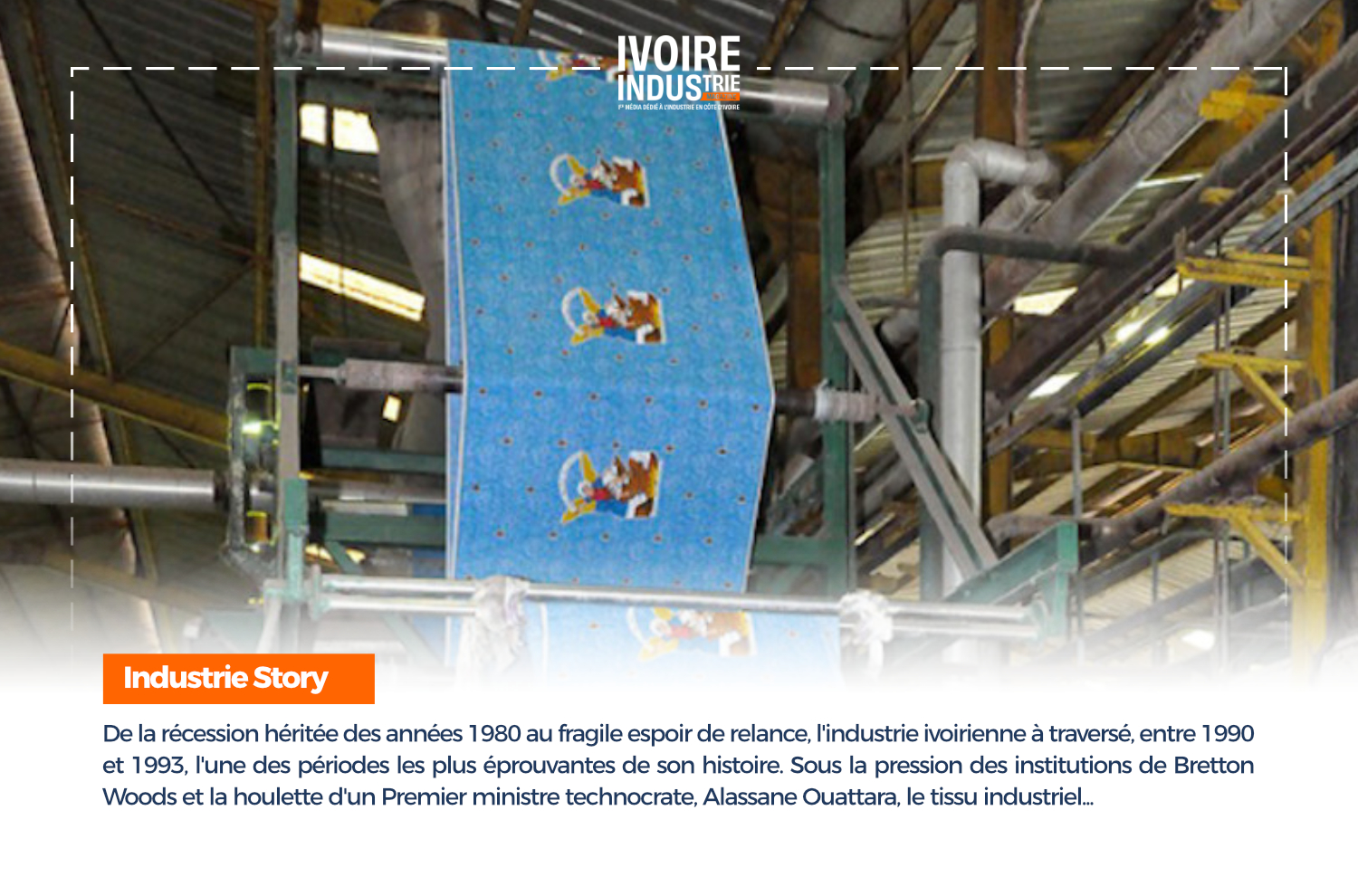
Depuis la fin des années 1970, l'industrie ivoirienne, longtemps vitrine du « miracle ivoirien », s'était progressivement fragilisée. Avec une stratégie d'industrialisation portée par des entreprises étatiques, celle-ci avait contribué à éroder la compétitivité du secteur manufacturier, qui n'avait jamais réussi à dépasser 20% du PIB, dont seulement 16% pour le secteur industriel moderne. Au début des années 1990, la Côte d'Ivoire traîne le poids d'un surendettement chronique, d'une exposition excessive aux fluctuations des prix des matières premières et d'un retard structurel dans sa politique d'industrialisation. La chute des cours du café et du cacao (moteur historique de l'économie nationale) avait siphonné les recettes publiques et asséché les investissements industriels. Dans le secteur industriel, l'emploi avait continué sa chute à un taux annuel moyen de 3% depuis 1986, tandis que le taux de croissance de la production, déjà nul en 1987, était devenu négatif, avec -2,8% en 1988 et -1,9% en 1989. C'est dans ce contexte de délitement que s'ouvre la décennie 1990.
Le tournant de la stabilisation
L'année 1990 marque un tournant institutionnel décisif. Le gouvernement ivoirien a mis en place un programme de stabilisation et de relance qui parvient à inverser la tendance à la dégradation de la situation budgétaire, malgré la baisse persistante des prix mondiaux des produits agricoles. La nomination d'Alassane Ouattara au poste de Premier ministre en novembre 1990 incarne cette volonté de réforme. Économiste de formation et ancien fonctionnaire du FMI, il mène une politique de rigueur exceptionnellement appréciée par l'ensemble des partenaires techniques et financiers du pays. C'est également en 1990 que débute effectivement le plan de privatisation des entreprises publiques, sous l'impulsion des institutions de Bretton Woods. Le Premier ministre annonce l'intention de transférer au secteur privé pas moins de quatre-vingts entreprises publiques. L'ambition est grande. Il s’agit d’assainir les finances de l'État, rendre l'industrie compétitive et attirer les capitaux étrangers. La Compagnie Ivoirienne d'Électricité (CIE) est le premier grand prix, sa gestion est cédée à une filiale de Bouygues-SAUR, marquant une rupture symbolique avec le modèle interventionniste qui avait prévalu depuis l'indépendance.
Une privatisation au ralenti
Pourtant, les résultats sont bien en deçà des ambitions affichées. Freiné jusqu'en 1993 par les réticences des parlementaires et de la haute fonction publique, le plan de privatisation ne progresse que très lentement. Sur le nombre d’entreprises annoncées, seulement quelques-unes avaient effectivement changé de mains à cette date. À savoir des entreprises d'édition, de villages-vacances, d'élevage et la CIE. Le tissu industriel, lui, reste sous contrôle public dans ses grandes composantes stratégiques. Cette résistance au changement révèle les contradictions profondes du modèle ivoirien. L'État, loin de se désengager massivement comme le prescrivaient les institutions financières internationales, demeure omniprésente dans le système productif. Les secteurs des hydrocarbures, de l'agroalimentaire et des industries diverses restent en attente de réforme. Ce n'est qu'en 1993, sous la pression renouvelée du Président Houphouët-Boigny lui-même (qui renouvelle publiquement son soutien à son Premier ministre) que le programme reprend de la vigueur, avec une dizaine de sociétés d'économie mixte inscrites à l'agenda des cessions.
Des secteurs en recomposition
Parallèlement aux privatisations, la période voit s'engager un vaste mouvement de désengagement progressif de l'État dans plusieurs secteurs industriels stratégiques. Le Complexe d'Exploitation industrielle du Bétail (CEIB), la Régie des Chemins de fer Abidjan-Niger (RAN), l’Énergie Électrique de Côte d’Ivoire (EECI) et la SODECI font partie des entreprises ciblées par cette vague de réformes structurelles. Le secteur minier et les BTP, ainsi que l'agroalimentaire, demeurent des piliers de l'économie, même si leur contribution au PIB reste insuffisante pour compenser les pertes sauvegardées dans les industries manufacturières. Dans ce contexte de recomposition difficile, les investissements étrangers constituent un signal d'espoir. Le gouvernement souligne leur progression, notamment dans les secteurs ciblés par les privatisations, avec une hausse de trente milliards de francs CFA annoncée pour la période 1990-1991. Ces entrées de capitaux, même modestes, témoignent d'une crédibilité retrouvée sur les marchés internationaux, conséquence directe de la politique d'assainissement conduite par le Premier ministre de l’époque.
Notons que la période 1990-1993 constitue une charnière ambivalente dans l'histoire industrielle de la Côte d'Ivoire. Elle ne fut ni une rupture salvatrice ni une simple continuité de la crise. Ce fut un ajustement laborieux, une situation de contrainte extérieure, et de résistance intérieure. Les réformes engagées ont posé les fondements d'un renouveau, qui ne se matérialisera pleinement qu'après la dévaluation du franc CFA en 1994, mais elles ont aussi révélé les limites structurelles d'un modèle industriel trop dépendant des matières premières et de la commande publique.