 English
 Français

Depuis 1946, le franc CFA était arrimé au franc français à parité fixe. Cette stabilité artificielle avait longtemps profité aux importateurs et aux élites urbaines, mais elle condamnait les exportateurs locaux à une compétitivité anémique sur les marchés internationaux. La Côte d'Ivoire, premier producteur mondial de cacao, voyait pourtant ses recettes s'effriter. Le pays « était dans l'incapacité de devenir compétitif dans le secteur manufacturier du fait de ses coûts excessifs et de sa productivité trop faible », et ne parvenait plus à attirer les investissements étrangers privés directs. Au tournant des années 1990, la situation budgétaire devient critique. Les avoirs extérieurs s'épuisent, la balance des paiements plonge dans le rouge, et le service de la dette dévore les recettes fiscales. Paris, sous injonction du FMI et de la Banque mondiale, durcit le ton. Ainsi, à compter du 1er janvier 1994, aucune aide financière ne serait versée aux pays n'ayant pas conclu d'accord d'ajustement structurel. Abidjan, qui attendait des fonds importants, se retrouve les mains vides. La dévaluation, longtemps repoussée comme un tabou politique, devient inévitable.
Le choc du 12 janvier : une décision imposée
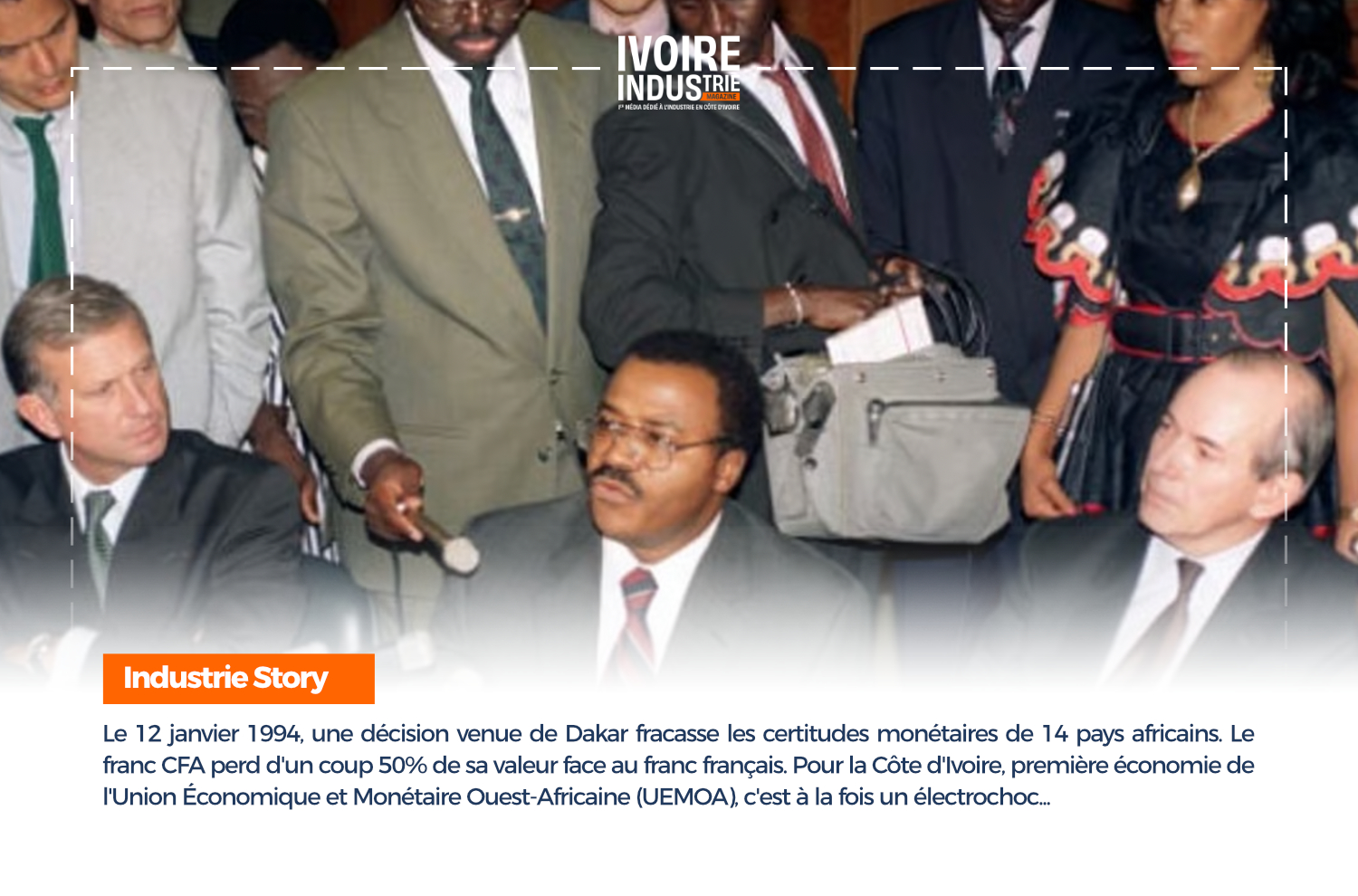
C'est dans une suite d'hôtel à Dakar, le 11 janvier 1994, que le ministre français de la Coopération Michel Roussin annonce la dévaluation officielle de 50% du franc CFA. La mesure, négociée dans le secret entre Paris, le FMI et les chefs d'État africains, est présentée comme un mal nécessaire pour redresser les économies de la zone franc en déclin. Pour la Côte d'Ivoire, cela signifie concrètement que la valeur de sa monnaie face au franc français tombe de 1 FCFA = 0,02 FF à 1 FCFA = 0,01 FF. L'onde de choc est immédiate. Les prix des biens importés (denrées alimentaires, équipements industriels, médicaments) s’envolent. Le pouvoir d'achat des ménages ivoiriens chute d'environ 40%. Les classes populaires et les fonctionnaires, payés en FCFA dévalués, absorbent de plein fouet l'inflation importée, exacerbant les inégalités sociales.
L'industrie ivoirienne : entre paralysie et renaissance
Le secteur industriel, fortement dépendant des intrants importés (machines, matières premières transformées, énergie), subit une hausse brutale de ses coûts de production. Les industries de transformation, notamment dans le textile et l'agroalimentaire, voient leurs marges s'éroder avant même d'avoir pu bénéficier des effets de compétitivité attendus. Cependant, les effets à moyen terme dessinent un tableau plus nuancé. En rendant les exportations ivoiriennes moins chères sur les marchés mondiaux, la dévaluation relance spectaculairement l'excédent commercial. Les filières cacao et café, épines dorsales de l'économie nationale, voient leurs recettes d'exportation bondir. À fin 1996, l'inflation est maîtrisée et la balance des paiements de la zone UEMOA passe de -39 milliards à +772 milliards de FCFA. Pour la filière bois, la dévaluation pousse à favoriser la transformation locale. Quelque 70 usines voient le jour, employant 15 000 personnes et générant 100 milliards de FCFA de chiffre d'affaires. Les investissements privés, autre baromètre de la confiance, commencent à remonter, passant de 7,5% du PIB en 1994 à une cible de 15% dès 1995. La Côte d'Ivoire est même saluée par Le Monde dès 1995 comme « le pays de la zone franc à avoir tiré le plus grand bénéfice de la dévaluation ».
Notons que la dévaluation de 1994 restera comme l'une des décisions monétaires les plus controversées de l'histoire économique africaine. Elle a infligé une douleur sociale réelle et immédiate aux populations les plus fragiles, tout en offrant aux exportateurs agricoles et à l'industrie locale une fenêtre de compétitivité inédite. Elle révèle surtout une vérité structurelle que les politiques africains tardaient à admettre, aucune monnaie ne peut durablement prospérer en s'affranchissant des réalités de la productivité nationale.