 English
 Français

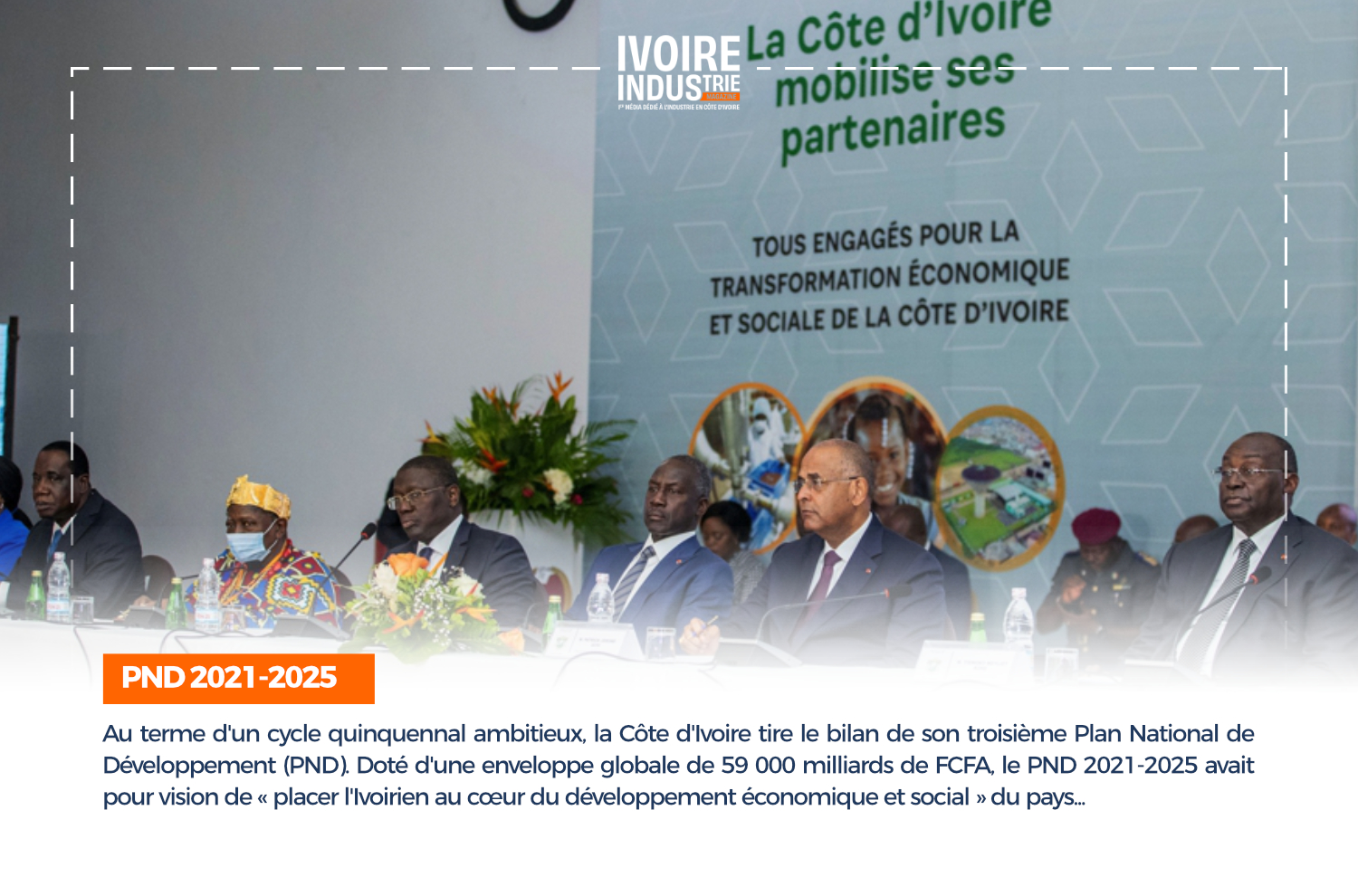
Le Plan National de Développement (PND) 2021-2025 s’inscrit dans la continuité des deux cycles précédents (2012-2015 et 2016-2020), qui avaient permis à la Côte d’Ivoire de réaliser un taux de croissance annuel moyen du PIB de 9,6% sur la période 2012-2015. En s’appuyant sur ces acquis, le Gouvernement, sous la conduite du Président de la République S.E. Alassane OUATTARA, a élaboré une feuille de route plus ambitieuse, guidée par un objectif global et structurant, opérer la transformation économique et sociale nécessaire afin de hisser le pays, à l’horizon 2030, au rang des États à revenu intermédiaire de la tranche supérieure. Cette vision repose sur des documents de référence majeurs. Elle s’appuie notamment sur l’Étude Nationale Prospective Côte d’Ivoire 2040 et le Plan stratégique Côte d’Ivoire 2030, qui définissent des orientations de long terme et des priorités opérationnelles. Par ailleurs, le PND intègre pleinement les Objectifs de Développement Durable (ODD), afin d’assurer une trajectoire de développement inclusive, durable et résiliente. Il prend également en compte la Vision 2063 de l’Union Africaine, contribuant ainsi à l’ancrage de la Côte d’Ivoire dans les dynamiques régionales et continentales.
Une stratégie inclusive
La stratégie du PND 2021-2025 repose sur 5 piliers fondamentaux, à savoir l’accélération du développement du capital humain et du bien-être social, la transformation structurelle de l'économie par l'industrialisation, le développement d'infrastructures harmonieusement réparties sur le territoire national, la préservation de l'environnement et le renforcement de l'intégration régionale et de la coopération internationale. À ces axes s'ajoute un 6 pilier transversal, celui de la consolidation du triptyque « Paix-Sécurité-Justice » pour renforcer la cohésion sociale et maintenir la stabilité. Cette architecture stratégique vise notamment à réduire de moitié le taux de pauvreté et à doubler le revenu par habitant entre 2020 et 2030, posant les jalons d'un développement inclusif. Sur le plan financier, le défi a été relevé avec un succès retentissant. Lors du Groupe Consultatif pour le financement du PND (GCPND) tenu en juin 2022 à Abidjan, sur un objectif initial de 9 335 milliards de FCFA de financements extérieurs, la Côte d'Ivoire a réussi à mobiliser 15 706 milliards de FCFA, soit un taux de mobilisation exceptionnel de 168,25%. Le Premier Ministre de cette période, Patrick Achi avait alors annoncé que d'autres engagements de partenaires multilatéraux et bilatéraux étaient encore attendus, au-delà de ce chiffre record. L'essentiel du financement du plan global de 59 000 milliards de FCFA reste cependant attendu du secteur privé, que le gouvernement entend ériger en véritable moteur de l'économie ivoirienne.
Des résultats tangibles sur le terrain
Les premières années d'exécution ont produit des résultats mesurables. À fin 2023, le PIB ivoirien affichait un taux de croissance de 6,5%, en hausse par rapport aux 6,2% enregistrés en 2022, confirmant la résilience de l'économie nationale. Sur le plan des investissements publics en infrastructure éducative, 2 181 nouvelles salles de classe ont été construites au préscolaire, 10 384 salles au primaire et 342 nouveaux collèges édifiés entre 2021 et 2024. Dans le secteur sanitaire, 22 établissements de santé ont été réhabilités et 14 nouveaux centres de santé construits, accompagnés de la mise à disposition de 22 ambulances. Le taux de couverture en électricité a progressé pour atteindre 82,4%, tandis que le taux de mortalité maternelle a chuté de 614 à 385 pour 100 000 naissances vivantes. Au-delà des infrastructures, les indicateurs sociaux ont enregistré des avancées notables. Le taux de participation des jeunes de 15 à 24 ans aux programmes d'alphabétisation est passé de 43,9% en 2016 à 84% en 2022-2023, traduisant un bond qualitatif dans le développement du capital humain. L'indice de parité filles/garçons au primaire a évolué en faveur des filles, une avancée significative dans la promotion de l'équité de genre. Ces progrès s'inscrivent dans un contexte où 68,1% des annonces de financement du Groupe Consultatif ont été concrétisées à fin 2023, soit 17 833 millions de dollars américains sur les 26 179,60 millions annoncés.
Ainsi, le PND 2021-2025 s'achève en laissant une empreinte durable sur la trajectoire économique et sociale de la Côte d'Ivoire. Succédant directement à ce troisième cycle de planification, le PND 2026-2030 a d'ores et déjà été mis en chantier, avec une enveloppe annoncée de 175 milliards d'euros pour bâtir les fondations d'une Côte d'Ivoire encore plus compétitive et inclusive. Cette continuité dans la planification stratégique témoigne de la maturité des institutions ivoiriennes et de leur capacité à inscrire le développement dans le temps long. En 5 ans, la Côte d'Ivoire n'a pas seulement investi dans les routes, les écoles et les hôpitaux, elle a surtout investi dans la confiance, celle des partenaires et celle de ses propres citoyens, condition première de toute émergence durable.