 English
 Français

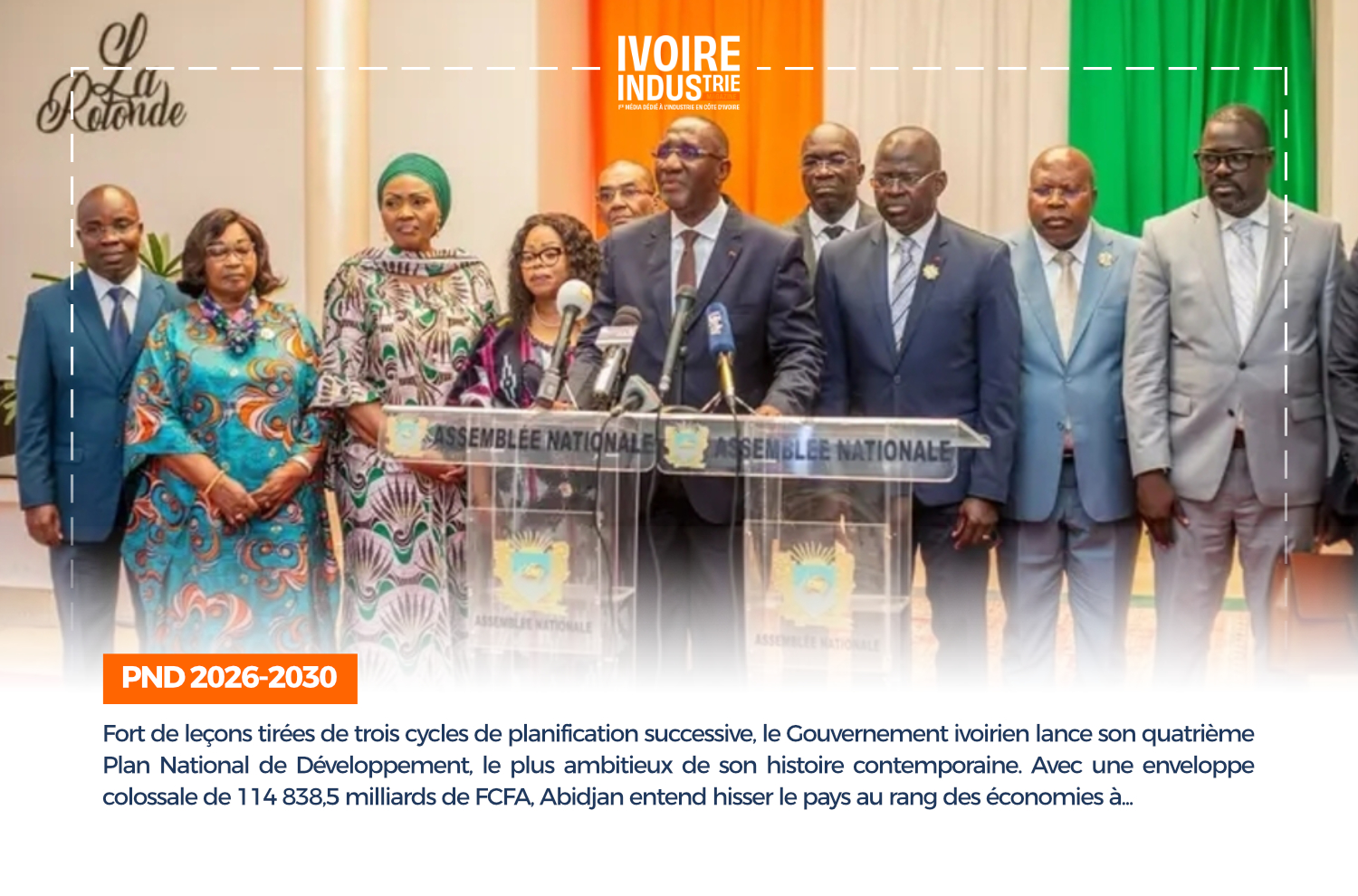
Depuis le retour à la stabilité politique en 2011, la Côte d'Ivoire a bâti son développement sur des cycles de planification quinquennaux successifs. Les PND 2012-2015, 2016-2020 et 2021-2025 ont profondément remodelé la trajectoire économique et sociale du pays, avec une croissance moyenne de 6,5% enregistrée lors du dernier cycle. C'est dans cette continuité que le Président de la République, S.E Alassane OUATTARA a engagé son gouvernement, lors du Conseil des ministres du 4 février 2026, dans l'adoption du quatrième Plan National de Développement. Pensé comme un cadre stratégique de développement inclusif et durable, le PND 2026-2030 s'inscrit également dans la vision prospective « Côte d'Ivoire 2040 ».
Six piliers pour transformer l'économie adossés à des objectifs macroéconomiques ambitieux
L'architecture stratégique du plan repose sur six piliers fondamentaux que sont la consolidation de la sécurité et de la stabilité, la modernisation de l'agriculture, la promotion de l'investissement privé, le développement du capital humain, le renforcement des infrastructures stratégiques et la promotion de la bonne gouvernance. Sa mise en œuvre s'appuie également sur une matrice de réformes couvrant 22 domaines prioritaires, un portefeuille de projets structurants et un dispositif renforcé de suivi-évaluation. Dans sa philosophie globale, ce nouveau plan prend en compte les aspirations profondes de la jeunesse ivoirienne, notamment en matière d'emploi, de formation et d'inclusion sociale. En ce qui concerne les objectifs macroéconomiques, les cibles fixées par le gouvernement sont à la hauteur de l'investissement consenti. La Côte d'Ivoire projette une croissance économique moyenne de 7,2% sur la période 2026-2030, avec un taux d'investissement devant atteindre 34,5% du PIB. Sur le plan social, l'objectif est de ramener le taux de pauvreté en dessous de 20% d'ici 2030, tout en élevant le revenu moyen par habitant à 4 000 dollars. L'ensemble de ces cibles converge vers une ambition centrale, faire intégrer la Côte d'Ivoire dans le groupe des pays à revenu intermédiaire de la tranche supérieure, conformément aux engagements pris dans le cadre de la vision 2040.
Un financement dominé par le secteur privé, avec un suivi rigoureux de l’État
La grande singularité du PND 2026-2030 réside dans son architecture financière. Sur l'enveloppe globale de 175 milliards d'euros, 70,2% devront provenir du secteur privé, contre seulement 29,8% du secteur public. Ce pari sur le capital privé est assumé. Il traduit la volonté du gouvernement de faire de l'entreprise le moteur principal de la transformation structurelle du pays. Les besoins de financement public sont, quant à eux, estimés à 38 000 milliards de FCFA, qui seront mobilisés principalement sur le marché financier, en complément des ressources internes et des partenariats économiques. Un groupe consultatif est prévu à cet effet pour fédérer les partenaires techniques et financiers autour du plan. La réussite d’un tel plan ne reposera pas uniquement sur la mobilisation de ressources. Et le gouvernement en est conscient. C’est pour cela qu’il a mis en place un dispositif de gouvernance rigoureuse et un mécanisme de suivi-évaluation performant, impliquant fortement les acteurs publics et privés. Son élaboration elle-même s'est inscrite dans une démarche de concertation élargie, impliquant les administrations, la société civile et le secteur privé. Ce processus participatif constitue l'un des gages de sa légitimité et de son appropriation par l'ensemble des acteurs du développement national.
En engageant le programme d'investissement le plus ambitieux de son histoire récente, la Côte d'Ivoire confirme sa volonté de consolider une décennie de croissance soutenue. Le PND 2026-2030 ne se limite pas à un exercice de planification budgétaire, il représente un projet de société qui mise sur la transformation structurelle, la jeunesse et l'initiative privée pour bâtir, d'ici la fin de la décennie, une nation solidaire, compétitive et résiliente.