 English
 Français

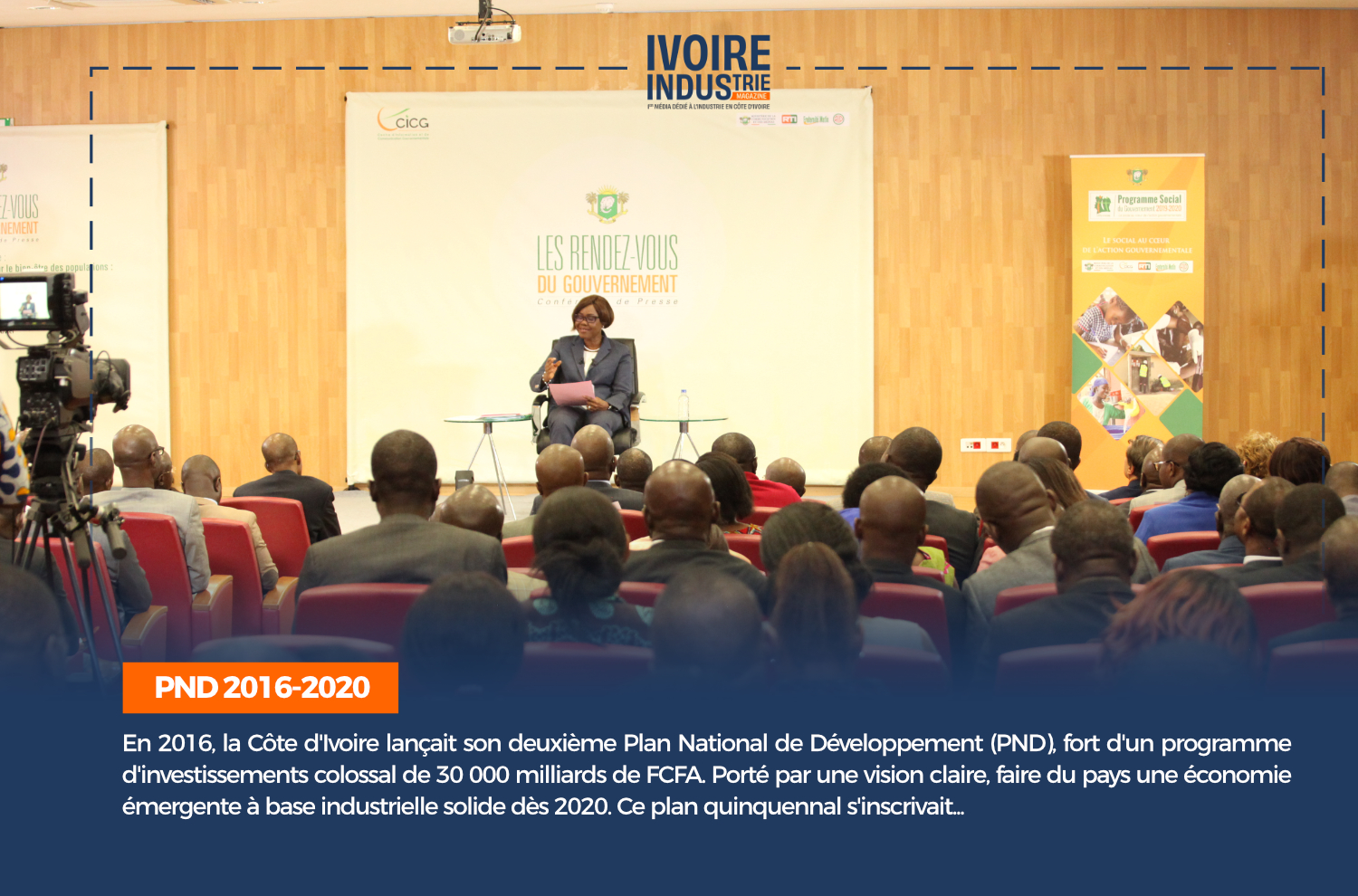
Adopté après une décennie marquée par les crises politico-militaires, le Plan National de Développement (PND) 2016-2020 se fixait un objectif global aussi symbolique que structurant, à savoir faire de la Côte d'Ivoire un pays émergent à l'horizon 2020 avec une base industrielle solide. Il prenait appui sur les acquis du PND 2012-2015, dont la croissance annuelle moyenne du PIB réel avait atteint 9% avec plus de deux millions d'emplois créés en quatre ans. Le défi du nouveau plan était d'une autre nature, celui de transformer en profondeur l’économie du pays, en la dotant d'une industrie manufacturière compétitive, capable de valoriser ses matières premières et de réduire durablement la pauvreté. Les objectifs spécifiques du PND 2016-2020 couvraient un spectre large tels que réaliser une croissance forte, durable, équitable et créatrice d'emplois, améliorer significativement les conditions de vie des populations, renforcer la bonne gouvernance et développer des infrastructures harmonieusement réparties sur l'ensemble du territoire national. Plus qu'un simple programme d'investissements, ce plan se voulait une feuille de route vers un nouveau modèle de développement.
Cinq axes pour transformer la nation
La stratégie du PND 2016-2020 s'articulait autour de 5 grands axes stratégiques complémentaires. Le premier portait sur le renforcement de la qualité des institutions et de la gouvernance, condition sine qua non pour attirer les investisseurs et assurer l'efficacité des politiques publiques. Le deuxième visait l'accélération du développement économique par l'industrialisation, notamment la valorisation des matières premières agricoles et la diversification de l'appareil productif industriel. Le troisième axe s'attachait au développement du capital humain et à l'amélioration des services sociaux de base, reconnaissant que l'émergence économique ne pouvait se construire sans une population éduquée, en bonne santé et protégée socialement. Le quatrième axe ciblait le développement d'infrastructures de qualité (routes, ports, énergie, numérique) pour désenclaver les régions et connecter le pays à l'économie mondiale. Enfin, le cinquième axe promouvait le renforcement de l'intégration régionale et de la coopération internationale, faisant de la Côte d'Ivoire un hub au cœur de l'Afrique de l'Ouest.
Une mobilisation financière sans précédent
Le volume global du programme d'investissements du PND 2016-2020 s'élevait à 30 000 milliards de FCFA, soit l'équivalent de 50 milliards de dollars américains. Ce montant colossal illustrait la confiance du gouvernement dans sa capacité à mobiliser des ressources aussi bien publiques que privées, nationales qu'internationales. La répartition était révélatrice d'une orientation libérale assumée. Quelque 37,6% à la charge du secteur public, représentant 11 284 milliards de FCFA, contre 62,4% attendus du secteur privé, soit 18 716 milliards de FCFA. Pour couvrir les besoins spécifiques de l'investissement public, les bailleurs de fonds internationaux avaient annoncé lors du Groupe Consultatif des engagements totalisant 7 700 milliards de FCFA, dont 6 350 milliards de nouveaux financements. Le besoin total de financement pour l'investissement public sur la période 2017-2020 s'établissait à 4 425,2 milliards de FCFA, soit 7,4 milliards de dollars. Cette architecture financière mixte, combinant budget de l'État, partenaires techniques et financiers, investisseurs privés nationaux et étrangers, constituait une innovation par rapport aux modèles de planification antérieurs.
Des résultats en demi-teinte, entre avancées réelles et ambitions reportées
La mise en œuvre du PND 2016-2020 a enregistré des résultats tangibles, bien qu'inégaux selon les secteurs. Dès la première année d'exécution, le taux de réalisation des engagements s'établissait à 38%, avec un investissement privé représentant 66,9% du total contre une prévision initiale légèrement différente. Sur le plan macroéconomique, la Côte d'Ivoire a maintenu une dynamique de croissance soutenue, consolidant sa position parmi les économies les plus performantes d'Afrique subsaharienne. Dans le secteur social, des progrès notables ont été enregistrés, avec la construction et la réhabilitation de salles de classes, l'extension de la couverture sanitaire et la réduction progressive de la pauvreté monétaire, cohérente avec la baisse de la pauvreté multidimensionnelle observée en 2018. Le développement des infrastructures économiques a également progressé, avec des investissements dans les routes, l'énergie et le numérique permettant de désenclaver plusieurs régions du pays. Cependant, l'objectif central d'atteindre l'émergence à l'horizon 2020 avec une base industrielle pleinement développée n'a pas été totalement atteint dans les délais fixés. La transformation structurelle de l'économie, l'industrialisation poussée et la réduction de moitié du taux de pauvreté demeuraient des chantiers inachevés, que le PND 2021-2025 aura pour mission de prolonger.
Le bilan du PND 2016-2020, aussi nuancé soit-il, a indéniablement façonné la trajectoire de développement de la Côte d'Ivoire pour la décennie à venir. Il a posé les jalons d'une industrialisation progressive, renforcé la culture de la planification stratégique au sein de l'État, et ancré dans les mentalités l'idée que l'émergence n'est pas une utopie mais un processus continu. Successivement relayé par le PND 2021-2025, puis par le PND 2026-2030 doté de l'ambition de 175 milliards d'euros d'investissements, ce plan quinquennal restera dans l'histoire économique ivoirienne comme la première tentative sérieuse de rupture avec un modèle de croissance extraverti et peu transformateur. L'émergence ivoirienne, œuvre de longue haleine, se construit plan par plan, brique après brique, sous la vision du Président de la République, S.E Alassane OUATTARA.