 English
 Français

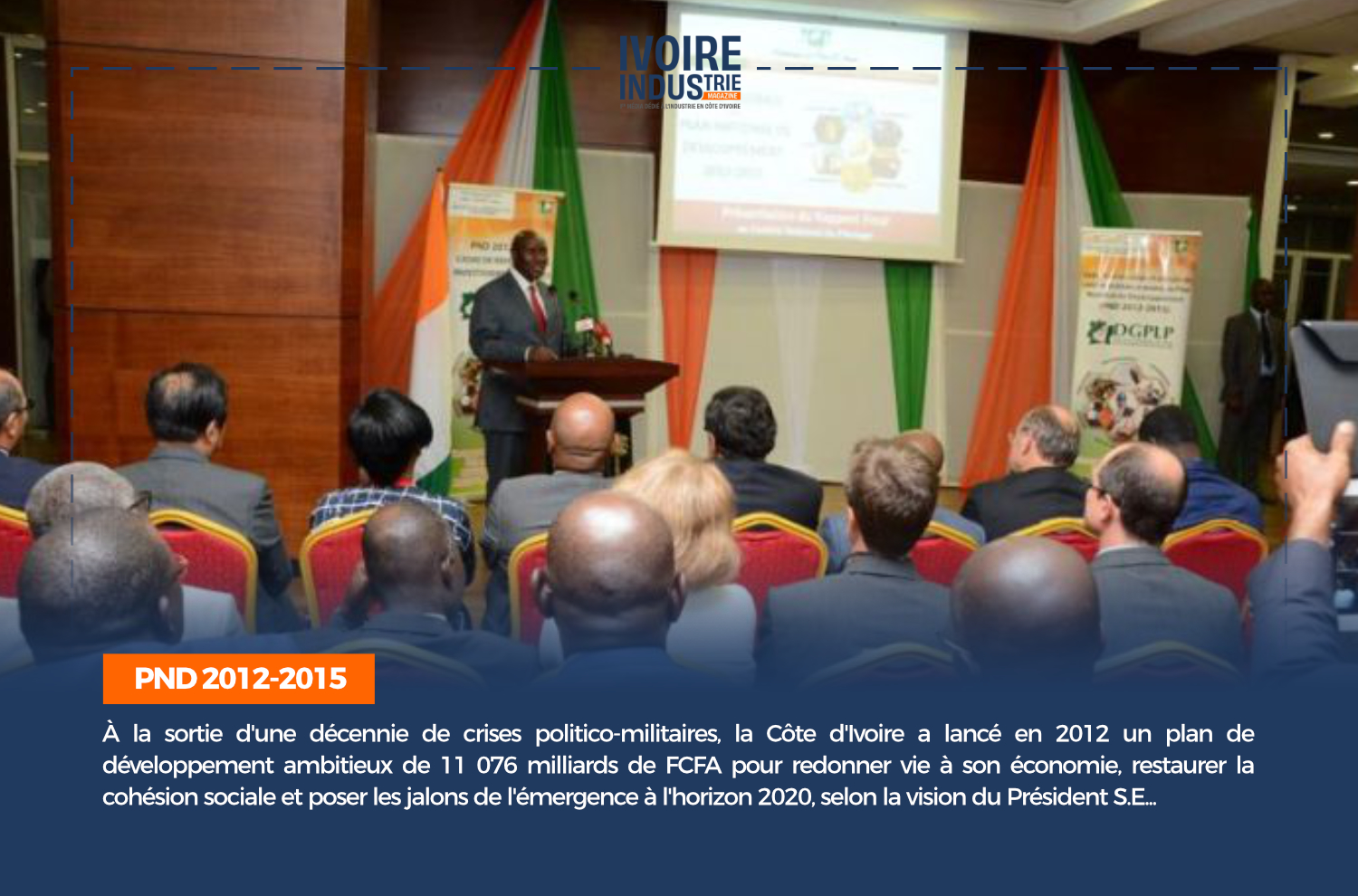
En 2011, la Côte d'Ivoire sort meurtrie d'une crise post-électorale qui a plongé le pays dans un recul économique de 4,1% de son PIB. Face à cette réalité, le gouvernement sous la houlette du Président de la République, S.E Alassane OUATTARA décide de structurer la reconstruction autour d'un outil de planification rigoureux, le Plan National de Développement (PND) 2012-2015. Ce document stratégique, aligné sur la vision « Côte d'Ivoire Émergente 2020 », constitue la première feuille de route nationale de l'ère post-conflit. Le PND 2012-2015 est construit autour de 5 résultats stratégiques, à savoir garantir la paix, la sécurité et la bonne gouvernance, accroître la création de richesses nationales, améliorer l'accès aux services sociaux de base, développer les infrastructures et renforcer l'intégration régionale. Ces piliers reflètent la double urgence du moment que sont la relance de l'économie nationale tout en restaurant le tissu social déchiré par les conflits.
Un financement colossal mobilisé sur la scène internationale
Le coût total du plan est évalué à 11 076 milliards de FCFA, un montant colossal pour un pays en reconstruction. Pour mobiliser ces ressources, le gouvernement organise un Groupe Consultatif, lors duquel les bailleurs de fonds publics s'engagent à apporter 8,6 milliards de dollars pour la période 2013-2015. Le financement repose sur un triptyque associant ressources de l'État, investissements privés nationaux et étrangers, et appui des partenaires techniques et financiers. La répartition sectorielle des fonds reflète les priorités affichées. Ainsi, environ 25% des investissements sont consacrés aux infrastructures, notamment routières, tandis que 5,5% sont alloués au secteur de l'énergie. Sur la période 2012-2014, les ressources budgétaires allouées s'élèvent à 1 679,3 milliards de FCFA, absorbées à hauteur de 74,65%, tandis que le taux d'exécution financière global du PND atteint 109,54%, un signe de dynamisme dans la mise en œuvre, bien qu'inégal selon les secteurs.
Des résultats économiques au-delà des attentes
Sur le plan macroéconomique, le bilan est spectaculaire. La Côte d'Ivoire renoue avec une croissance forte et soutenue, affichant un taux annuel moyen de 9,6% du PIB sur la période. Ce résultat propulse le pays parmi les économies à la plus forte progression du continent africain. Plus de 02 millions d'emplois sont créés sur ces 04 années, témoignant d'un réel dynamisme du tissu productif. Dans le secteur agricole, le Programme National d'Investissement Agricole (PNIA) mobilise 30% des investissements requis, soit 740 milliards de FCFA, permettant de relancer une filière dont dépend la majorité de la population rurale. Des infrastructures majeures sont construites ou réhabilitées dans les domaines des transports, de l'énergie et de l'habitat, contribuant à la modernisation progressive du cadre de vie des Ivoiriens.
Des avancées sociales réelles, des défis qui demeurent
Sur le plan social, les dépenses dites « pro-pauvres » progressent sensiblement, passant de 1 080 milliards de FCFA en 2012 à 1 337 milliards de FCFA en 2013. Cette évolution traduit une volonté politique affichée d'améliorer l'accès aux services de base, notamment dans les domaines de l'éducation, de la santé et de l'eau potable. Cependant, l'exécution financière reste inégale selon les résultats stratégiques. Pour le résultat lié à la gouvernance, seulement 584,9 milliards de FCFA sur les 1 060,7 milliards prévus sont mobilisés, révélant des goulots d'étranglement institutionnels. La sécurité et la cohésion sociale, socles indispensables du développement, progressent mais restent fragiles dans certaines régions. Ces lacunes alimenteront les réflexions qui présideront à l'élaboration du PND suivant, confirmant que la planification nationale est avant tout un processus d'apprentissage continu.
Retenons que le PND 2012-2015 restera dans l'histoire économique ivoirienne comme le plan de la renaissance. En redressant une économie dévastée par 10 ans de turbulences, il a posé les fondations sur lesquelles se construiront les plans suivants. Son élaboration et son exécution montre que la planification stratégique, adossée à une mobilisation sincère des partenaires et à une gouvernance rigoureuse, peut transformer une nation en profondeur, même dans les contextes les plus adverses.