
 English
 Français

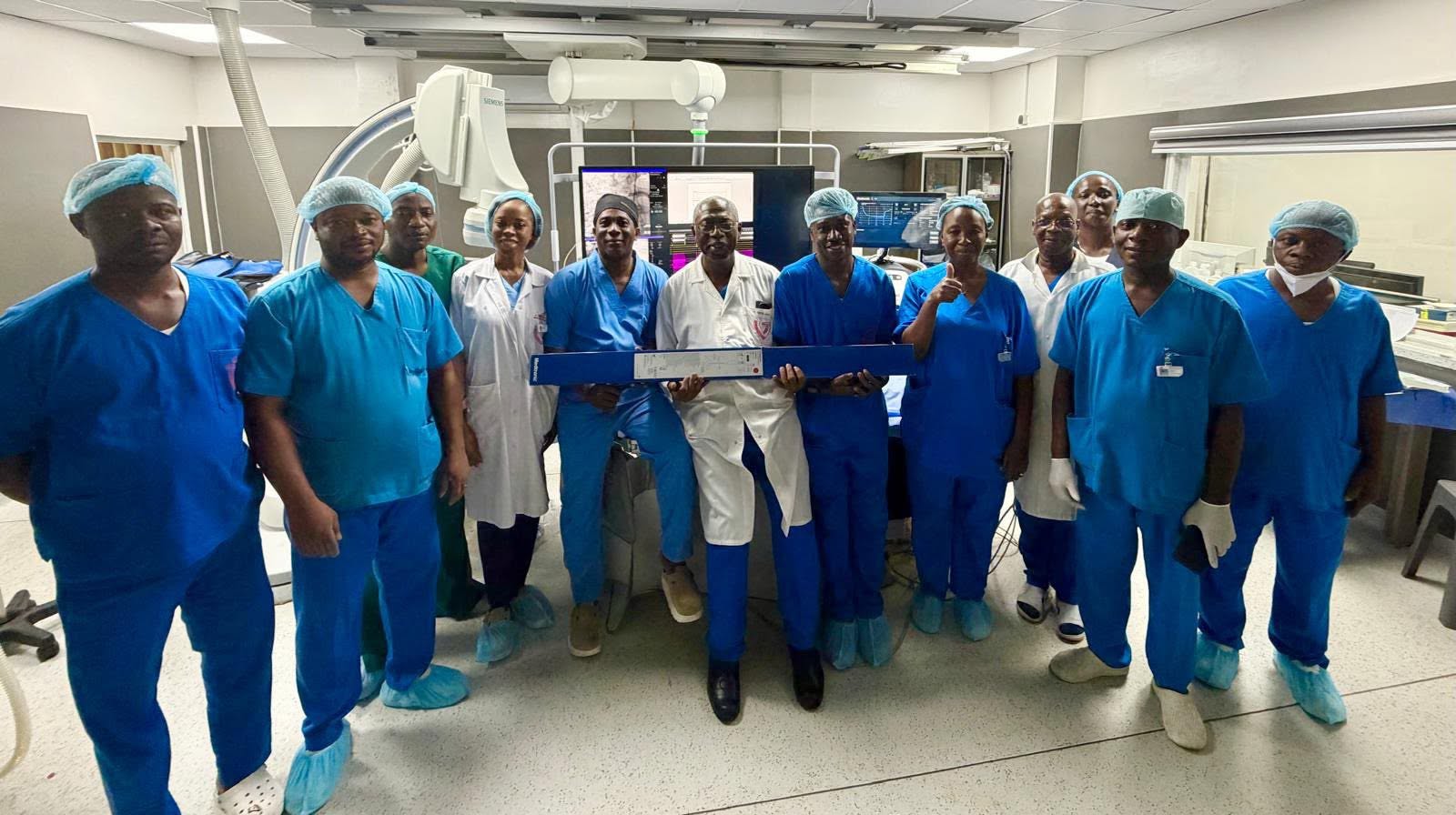
L’Institut de Cardiologie d’Abidjan (ICA) a réalisé récemment la première ablation de fibrillation auriculaire jamais pratiquée en Afrique subsaharienne. Effectuée sur une patiente de 56 ans souffrant d’une forme très symptomatique de cette arythmie, l’intervention s’est déroulée avec succès. La malade a quitté l’établissement dès le lendemain. Au-delà de la performance médicale, cette opération marque l’arrivée dans la sous-région d’une technique de pointe jusqu’alors réservée à quelques centres spécialisés d’Europe, d’Amérique et d’Afrique du Nord. L’intervention a été réalisée par une équipe de rythmologues composée des professeurs Adoubi Annicet et N’Djessan Jean-Jacques ainsi que du docteur Kouamé Stéphane. Une équipe multidisciplinaire associant l’anesthésiste Dr Tshihiluka, le professeur Ncho-Mottoh pour le scanner cardiaque et le Dr Angoran pour le guidage échographique a participé à la prise en charge. Une mission médicale canadienne regroupant des spécialistes de l’Institut de cardiologie de Montréal et de l’Hôpital du Sacré-Cœur de Montréal était également présente. L’opération a bénéficié du soutien du groupe Mitrelli. Cette intervention ouvre de nouvelles perspectives pour des milliers de patients d’Afrique de l’Ouest confrontés à la fibrillation auriculaire, une maladie encore peu connue du grand public mais considérée comme le trouble du rythme cardiaque le plus fréquent dans le monde.
Une maladie qui gagne du terrain en Afrique
Selon les données du Global Burden of Disease Study publiées dans The Lancet, près de 59,7 millions de personnes vivaient avec une fibrillation auriculaire en 2019. Cette affection est responsable d’environ 315 000 décès par an à travers le monde. Elle constitue également l’un des principaux facteurs de risque d’accident vasculaire cérébral. La fibrillation auriculaire se caractérise par une activité électrique désorganisée des oreillettes du cœur. Cette anomalie provoque des battements irréguliers susceptibles d’entraîner des palpitations, des douleurs thoraciques, un essoufflement, une fatigue chronique ou encore une baisse des capacités physiques. Chez certains patients, elle favorise la formation de caillots sanguins pouvant migrer vers le cerveau et provoquer un AVC. D’après l’Organisation mondiale de la santé, les maladies cardiovasculaires demeurent la première cause de mortalité dans le monde avec près de 19,8 millions de décès, soit environ 32 % de tous les décès en 2022. L’Afrique n’échappe pas à cette tendance. L’augmentation de l’espérance de vie, l’urbanisation, l’hypertension artérielle, le diabète et l’obésité contribuent à une progression continue des maladies cardiaques sur le continent.
En Côte d’Ivoire, l’hypertension artérielle (principal facteur de risque modifiable de développer l’arythmie) représente déjà un important problème de santé publique. L’étude « Traitement d'urgence des arythmies à l'Institut de cardiologie d'Abidjan » a montré que la fibrillation auriculaire figure parmi les troubles du rythme régulièrement rencontrés chez les patients hospitalisés. Les spécialistes observent une augmentation progressive des cas liée notamment au vieillissement de la population et à la fréquence croissante des facteurs de risque cardiovasculaires. Jusqu’à présent, les patients souffrant de formes sévères de fibrillation auriculaire avaient essentiellement recours aux traitements médicamenteux. Or, les antiarythmiques ne permettent pas toujours de contrôler durablement la maladie. Les récidives sont fréquentes et certains médicaments exposent à des effets secondaires importants. L’ablation par cathéter constitue aujourd’hui l’une des principales options thérapeutiques pour les patients symptomatiques. Elle consiste à introduire des sondes à travers les vaisseaux sanguins afin d’identifier les zones responsables des perturbations électriques et de neutraliser ces foyers anormaux. L’intervention est réalisée sans ouverture du thorax. Plusieurs études ont confirmé les bénéfices de cette technique. L’essai CASTLE-AF, publié dans le New England Journal of Medicine, a notamment montré une diminution des hospitalisations et une amélioration de la survie chez des patients souffrant également d’insuffisance cardiaque. Une méta-analyse publiée en 2022 dans Europace a également conclu à une réduction du risque de décès et d’hospitalisation grâce à cette approche.
Voir aussi : La Côte d'ivoire à la vice-présidence de l'OMS
Une avancée aux retombées bien au-delà de la Côte d'Ivoire
Pour les patients d’Afrique subsaharienne, l’arrivée de cette technologie à Abidjan pourrait modifier profondément les parcours de soins. Jusqu’à une période récente, les malades qui souhaitaient bénéficier d’une telle intervention devaient être évacués vers l’Europe, le Canada, le Maroc ou la Tunisie. Ces déplacements représentaient des coûts considérables auxquels s’ajoutaient les frais d’hospitalisation et de séjour. La disponibilité de cette technique en Côte d’Ivoire pourrait ainsi contribuer à réduire le recours aux évacuations sanitaires, un phénomène qui mobilise chaque année d’importantes ressources financières dans plusieurs pays africains. Elle offre également la possibilité d’une prise en charge plus rapide des patients et d’un meilleur suivi après l’intervention.Cette avancée conforte aussi la place de l’Institut de Cardiologie d’Abidjan parmi les centres de référence du continent. Fondé en 1976, l’établissement accueille des patients venus de plusieurs pays de la sous-région. Il s’est progressivement imposé dans les domaines de la chirurgie cardiaque, de la cardiologie interventionnelle et de la prise en charge des maladies cardiovasculaires complexes.
L’établissement s’était déjà illustré en réalisant la première angioplastie coronaire d’Afrique subsaharienne en 2010. Seize ans plus tard, cette première ablation de fibrillation auriculaire vient renforcer les capacités techniques du centre et élargir son offre thérapeutique. Au-delà, cette opération met en lumière les progrès accomplis dans la formation des spécialistes africains. Longtemps dépendants des structures étrangères pour certaines interventions complexes, plusieurs établissements du continent développent progressivement des compétences de haut niveau grâce à des partenariats internationaux et à des investissements dans les équipements médicaux. La diffusion de ces technologies demeure néanmoins confrontée à plusieurs défis. Les équipements nécessaires à l’électrophysiologie interventionnelle sont coûteux. Leur maintenance exige des moyens importants. La formation des cardiologues spécialisés demande également plusieurs années. La question du financement des soins constitue enfin un enjeu majeur pour les patients et les systèmes de santé.
Malgré ces contraintes, l’intervention du 4 juin constitue une étape importante dans l’évolution de la médecine spécialisée en Afrique subsaharienne. En permettant désormais la réalisation locale d’une procédure reconnue à l’échelle internationale, l’Institut de Cardiologie d’Abidjan élargit les possibilités thérapeutiques offertes aux patients et participe au développement d’une expertise régionale dans la prise en charge des troubles du rythme cardiaque.