 English
 Français

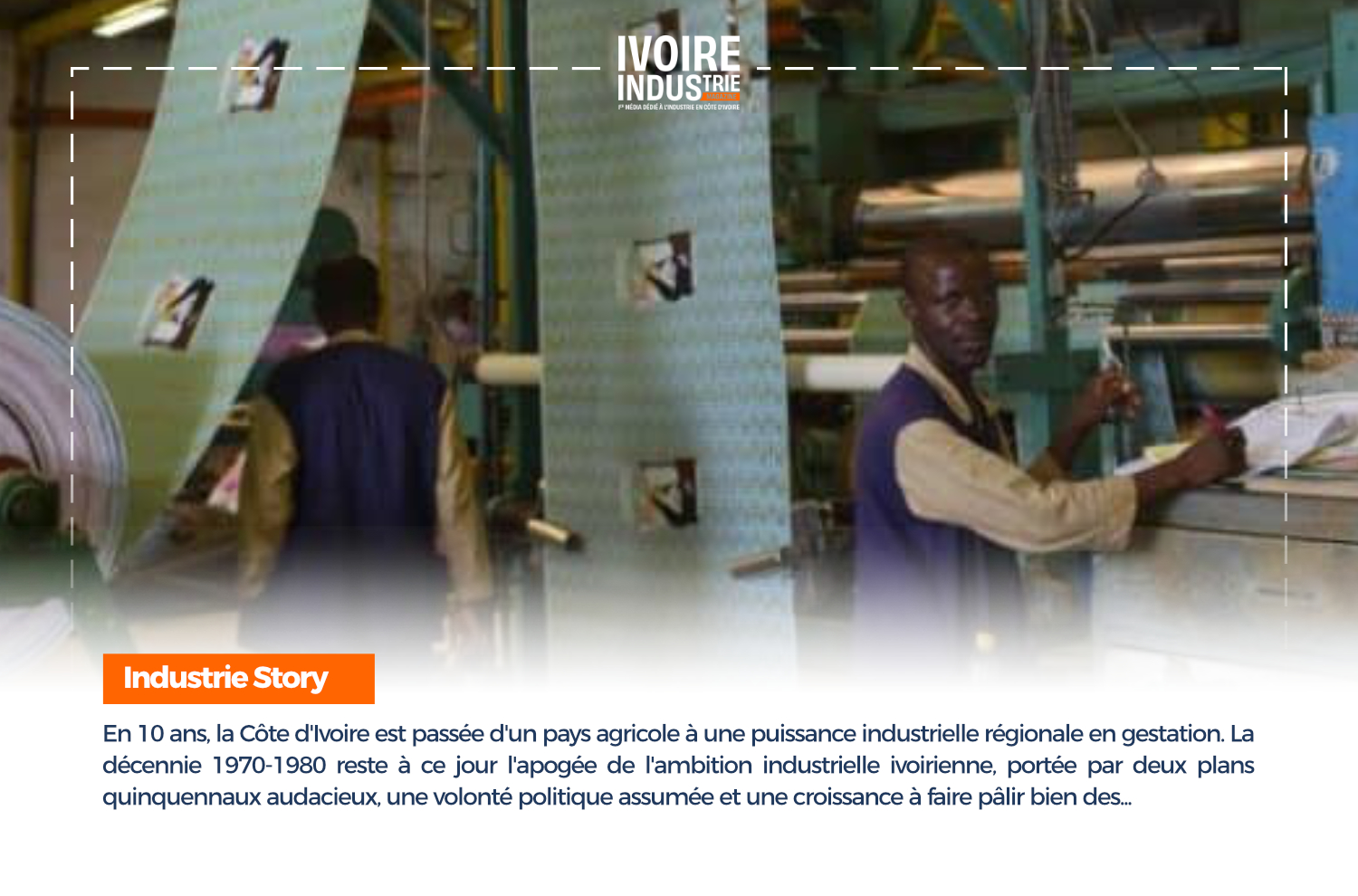
Pour comprendre ce que fut l'industrie ivoirienne dans les années 1970, il faut remonter quelques années en arrière. Dès l'indépendance en 1960, Félix Houphouët-Boigny avait fait un pari risqué, celui du libéralisme économique, dans un continent africain majoritairement acquis aux idéologies étatistes et socialistes. Son pari reposait sur une attraction résolue des capitaux étrangers, un code d'investissement généreux adopté dès 1959, et une stabilité politique savamment entretenue. La première décennie post-indépendance, de 1960 à 1970, avait déjà prouvé la pertinence de ce choix, car la production industrielle croissait à un taux moyen de 15% par an, portant la part de l'industrie dans le PIB de 15,2% à 25%. Le pays avait également réussi sa phase dite d' import-substitution, en développant des industries locales capables de remplacer progressivement les produits importés. Mais c'est dans les années 1970 que l'ambition industrielle ivoirienne allait prendre toute sa dimension.
1971-1975 : faire de l'industrie le moteur du pays
Avec l'adoption du premier plan quinquennal de développement industriel (1971-1975), l'État ivoirien franchit une étape décisive. La philosophie est claire, l’industrie ne doit plus être un secteur d'affectation de l'agriculture, elle doit en devenir le moteur principal du développement économique. Ce plan mise sur la valorisation des ressources locales, notamment agro-alimentaires et minières, tout en cherchant de nouveaux débouchés à l'exportation vers les pays extra-africains. L'État, via la Société Nationale de Financement (SONAFI), créée dès 1963, intensifie ses prises de participation dans les entreprises industrielles. Une attention particulière est portée à des filières prometteuses, à savoir la conservation d'ananas, l'industrie du thon, la transformation du coton, et le secteur stratégique de l'énergie. C'est également l'époque où les grandes entreprises textiles ivoiriennes connaissent leur heure de gloire, à l'image des Établissements Robert Gonfreville (ERG) à Bouaké, d'UTEXI à Dimbokro et de COTIVO à Agboville. Sur le plan social, les résultats sont tangibles. En 1977, le secteur industriel réalise un chiffre d'affaires total de 459 milliards de francs CFA et emploie 63 000 travailleurs. Le pays consacre 43 % de son budget à l'éducation, contre 25 % en moyenne dans les autres pays africains, pour renforcer la main-d'œuvre qualifiée dont son industrie naissante a besoin.
1976-1980 : le tournant vers l'exportation
Si le premier plan quinquennal visait à consolider les bases industrielles internes, le deuxième plan quinquennal de 1976 à 1980 marque une réorientation stratégique majeure. L’industrie ivoirienne doit désormais conquérir les marchés extérieurs. Ainsi, l’accent est mis sur le textile en vue de l'exportation de produits finis, de la valorisation des ressources locales à forte valeur ajoutée, et du développement de circuits d'exportation longue distance. L'engagement financier de l'État est considérable. Entre 1976 et 1980, il investit plus de 685 milliards de francs CFA en dépenses de développement industriel et en infrastructures. Cette injection massive de capitaux publics, combinée aux investissements étrangers (principalement français) porte ses fruits. En 1979, on dénombre 619 entreprises de production sur le territoire ivoirien, distribuant des salaires à hauteur de 75,2 milliards de francs CFA. Le PIB par habitant, qui était de 551 dollars US en 1960, atteint 1 068 dollars en 1979, soit une quasi-multiplication par deux en moins de vingt ans.
L'agro-industrie, colonne vertébrale d'une économie en plein essor
Si l'industrie ivoirienne de cette décennie brille par sa diversité, son moteur véritable reste l'agro-industrie, qui représente alors près de 50% du secteur industriel. Le cacao propulse la Côte d'Ivoire au sommet de la hiérarchie mondiale. En 1978, pour la première fois, le pays devient premier producteur mondial avec une production de 312 000 tonnes. La production de café atteint quant à elle 200 000 tonnes en 1980. Mais la dynamique ne se limite pas aux deux cultures reines. Sous l'impulsion des plans quinquennaux, de nouvelles filières sont activement développées, notamment l’hévéa, l'huile de palme, le coton, la canne à sucre. La zone du Sud-ouest est aménagée, la Vallée du Bandama est mise en valeur, et des infrastructures portuaires et urbaines soutiennent l'expansion industrielle. Abidjan, avec ses zones industrielles de Yopougon, Koumassi et Vridi, s'impose comme le premier hub industriel d'Afrique de l'Ouest francophone.
Une croissance sous perfusion étrangère
Derrière la splendeur des chiffres, les observateurs de l'époque décèlent une fragilité structurelle majeure. La Côte d'Ivoire croît, mais dans la dépendance. Selon les données publiées dans “Côte d'Ivoire en chiffres (édition 1980-1981)”, 54,43 % du capital social des entreprises est détenu par des intérêts étrangers, dont 31,94 % par la France seule, contre seulement 13,19 % par les privés ivoiriens. L'économiste Samir Amin parlait alors sans détour de « croissance sans développement », une expansion entretenue de l'extérieur sans que les structures socio-économiques locales ne permettent une autonomie future. Houphouët-Boigny lui-même avait conscience de cette limite. Il déclare : « Plus nous réfléchissons, plus nous apercevons que notre liberté sera illusoire si nous ne reprenons pas progressivement en main la gestion de notre économie…». Les accords de coopération franco-ivoiriens de 1961 réservaient en effet, dans leurs marchés publics, la priorité aux entreprises françaises ou ivoiriennes, ancrant le pays dans un partenariat économique asymétrique.
Pour conclure, à l'orée des années 1980, les signaux d'alerte se multiplient. Le choc pétrolier de 1979 alourdit les charges de l'État, fragilise les entreprises énergo-intensives, et compromet les équilibres budgétaires. La mauvaise gestion de nombreuses sociétés d'État (au nombre de 33 créées par le Président) transforme ces instruments de développement en gouffres financiers nécessitant des subventions croissantes. La Côte d'Ivoire commence à s'endetter sur les marchés financiers internationaux sans que les retours sur investissement estimés ne se matérialisent. Ce sont ces fragilités accumulées qui plongent le pays dans une grave crise économique dès 1981. Mais il serait injuste de laisser cette ombre éclipser l'éclat de la décennie 1970-1980, avec un taux de croissance industrielle de 7% par an pendant toute la période du « miracle ivoirien».